Canvas Wall Art for a First Home: A Room-by-Room Plan That Starts With a Tape Measure

Canvas wall art is artwork printed onto a cotton-poly weave and stretched over a wooden frame, so it hangs flat with no glass and no glare. In a first home that matters more than it sounds. Canvas is light, it survives the next move, and one correctly sized piece can settle a room that still feels half unpacked. The hard part is not taste. The hard part is scale, and scale is a measuring job.
Why canvas wall art earns its place in a new home
Weight is the first reason. A stretched canvas print has no glass, so a large piece stays light enough for a single wall anchor and light enough to move again when the lease ends or the layout changes. There is no separate framing bill either, because the frame sits inside the piece.
Glare is the second reason. Glass bounces window light and ceiling light back at you, and a bright new build has plenty of both. A matte canvas surface holds its image from any seat in the room, which helps in a living room where the sofa faces a window.
Scale is the third reason. Moving up a size on canvas costs far less than moving up a size in framed glass. New homes almost always have one or two walls that need a genuinely big piece, and canvas is the cheapest honest way to fill them.
Measure the wall before you shop for canvas prints
Blank walls play tricks. A wall that looks modest in an empty room reads as huge once furniture arrives, and most first-time buyers order a print that is far too small. Take three measurements before you open a single product page.
- Width of the furniture the art will sit above, in inches
- Width of clear wall, from edge to edge of any window trim, switch plate, or shelf
- Height from the floor to the top of that furniture
Write the three numbers on your phone. They decide almost everything that follows, and they save you the return shipping on a piece that arrives two sizes short.
The two-thirds rule for art above a sofa or headboard
Designers size artwork to the furniture, not to the wall. The width of a piece, or of a grouping treated as one unit, should land at about two-thirds to three-quarters of the width of the furniture below it. Run the math on your own room.
- 84-inch sofa: 56 to 63 inches of art
- 76-inch king headboard: 50 to 57 inches
- 60-inch queen headboard: 40 to 45 inches
- 48-inch console table: 32 to 36 inches
A 24 by 36 inch print above a full-size sofa is the most common sizing mistake in a new home. It reads as an afterthought. If the budget will not stretch to one large piece yet, buy two medium pieces and hang them as a pair, because a pair hung together is measured as one unit.
Hanging height: the numbers that stop artwork from floating
Two rules cover nearly every wall in a house. On an empty wall, put the center of the piece 57 to 60 inches from the floor. That height sits near average eye level and is the one galleries work from. Measure up from the floor, never down from the ceiling, or a high ceiling will push everything too far up.
Above a sofa, bed, or console, leave 6 to 10 inches between the top of the furniture and the bottom edge of the frame. Past about 12 inches the piece looks disconnected from what sits below it. In a dining room, drop the center a few inches lower, since everyone in the room is seated.
For a gallery grouping, treat the whole arrangement as one rectangle. Center that rectangle at 57 inches and keep 2 to 3 inches of gap between pieces.
Bedroom wall art: one focal wall, one calm subject
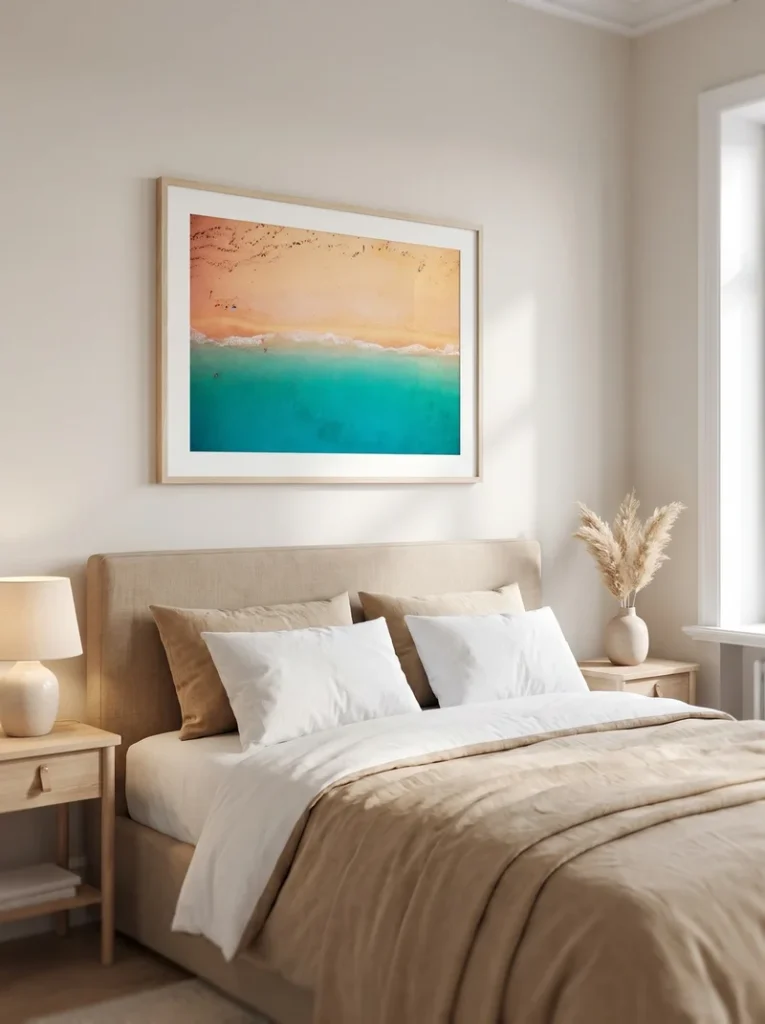
Bedrooms reward restraint. The wall above the headboard is the only wall that truly needs a piece, and the rest of the room does better with lamps and textiles than with more artwork. Pick one subject and let it stay quiet: still water, open sky, a single plant form, an abstract in two or three close colors. Busy scenes read as noise from a pillow.
Sizing follows the headboard, not the room. Bedroom wall art that spans two-thirds of the headboard width looks deliberate, and anything narrower looks stranded above a wide bed. If one wide print is out of reach, three narrow panels covering the same span do the same job for less.
Watercolor wall art and other styles that keep a small room open
Small rooms are the reason style matters. Dense, high-contrast images pull walls inward. Washed, open images push them back.
Watercolor wall art is the clearest example, with pale grounds, blended edges, and real white space inside the image, which the eye reads as more air in the room. Botanical line work, minimalist shapes, and pale coastal scenes behave the same way. Save deep, saturated pieces for a hallway or a room you walk past rather than one you sit in.
One more practical note on style in a first home: choose a palette before you choose subjects. Two or three colors repeated from room to room will hold a house together even when the furniture came from five different places.
Single panel or a multi-panel split on a wide wall
A wide wall gives you a real choice, and the two layouts behave differently.
A single panel is one clean statement. It suits a wall you see head on, above a sofa or a bed, and it is the simpler pick when nothing interrupts the span.
A multi-panel split spreads one image over two, three, or five sections with a narrow gap between them. It covers more width for less money, it handles long walls a single piece cannot reach, and the gaps keep a very large image from feeling heavy. Space the panels about 2 inches apart and measure the whole group as one rectangle.
Both layouts sit side by side in most canvas wall art catalogs, so the decision comes down to wall shape rather than budget alone.
What to buy first when every wall is blank
Order matters when the budget is thin. A sequence that works for most first homes:
- Living room focal wall above the sofa. Largest piece, biggest payoff.
- Bedroom headboard wall. Second largest, calm subject.
- Entry or hallway. One vertical piece at eye level sets the tone as people walk in.
- Dining area. One piece, hung a little lower for seated viewing.
- Everything else, including any gallery grouping, once the first four are done.
Buy one good large piece before you buy four small ones. Small prints scattered around a house rarely add up to a finished room, while a single correctly sized piece can make one room look finished on its own.
Frequently asked questions
What is a canvas print made from?
Canvas prints begin as artwork printed onto a cotton-poly weave with pigment inks, then stretched over a solid wooden frame and sealed with a protective matte coat. The finished piece hangs flat, weighs little, and needs no glass and no separate frame.
How big should a canvas print be above a sofa?
Two-thirds to three-quarters of the sofa width is the working range. An 84-inch sofa takes roughly 56 to 63 inches of artwork, measured either as one piece or as a group hung as a unit.
How high should wall art hang?
Center height of 57 to 60 inches from the floor works on an empty wall. Above furniture, the bottom edge should sit 6 to 10 inches above the top of the sofa, bed, or console.
Does canvas artwork suit a rented first home?
Rentals suit canvas well. Pieces are light enough for one anchor or a heavy-duty adhesive hook, they leave a single small hole instead of four, and they travel to the next address with no glass to crack.
What subjects work best over a bed?
Quiet subjects hold up best above a headboard: open water, sky, single botanical forms, and pale abstracts. Detail-heavy scenes read as visual noise in a room meant for rest.
Is a multi-panel set better than one large print?
Multi-panel sets cover wide walls for less money and suit long, uninterrupted spans. One large panel is stronger on a wall you view straight on, and it is simpler to hang level.