Winter Indoor Air Quality And Ducts

What Your HVAC System Is Really Circulating
When the first real frost settles across the neighborhood, most of us perform the exact same ritual: we walk over to the thermostat, nudge the temperature up a few degrees, and seal every window and exterior door against the biting chill. It feels cozy, responsible, and warm. What almost nobody thinks about in that moment is the sudden awakening of miles of hidden sheet metal, flex duct, and return plenums behind their drywall that have been quietly gathering dust all autumn. As an air duct technician who has spent more cold mornings than I care to count peering into residential trunks and commercial supply lines with a borescope camera, I can tell you that the first week of heavy furnace operation is always an eye-opener.
The Great Winter Lockdown Inside Your Building Envelope
Modern homes and commercial offices are engineered to be remarkably tight. Energy codes over the past two decades have pushed builders to seal rim joists, install double-pane low-E glass, and wrap structures in heavy air barriers to stop conditioned air from leaking outdoors. While that engineering marvel keeps your utility bills from skyrocketing in January, it also turns your property into a closed-loop terrarium. During spring and summer, open patio doors, cracked windows, and constant foot traffic dilute indoor pollutants with fresh outdoor air. Once winter locks the building envelope down, the air inside your living room or office suite gets recycled through your air handler dozens of times every single day.
Every time your blower motor kicks on, it pulls air through the return grilles, passes it across the heat exchanger, and pushes it back out through the supply registers. If your ductwork is harboring months or years of accumulated debris, your heating system becomes a high-efficiency distribution network for particulates you definitely did not invite to the holidays. Understanding how yourwinter indoor air quality changes when the windows stay shut is the first step toward keeping your family, tenants, or employees breathing comfortably until the spring thaw.
image_882004.png
What Actually Lives Inside Your Supply and Return Plenums
People often assume duct dust is just harmless gray lint, the same stuff you wipe off a bookshelf on a Saturday morning. When we hook up a high-static negative air machine and agitate the interior walls of a trunk line with rotary brushes or compressed air whips, what comes out tells a much more interesting story. Return ducts act like giant vacuum hoses for your entire floor plan. Because they operate under negative pressure, any tiny gap in unsealed sheet metal seams pulls in insulation fibers, sawdust from long-forgotten remodeling projects, drywall dust, and pet dander straight from wall cavities and crawlspaces.
On the supply side, things get even trickier. Even with a standard pleated filter sitting in the filter rack, microscopic particles slip past the media—especially if the filter frame does not fit snugly against the cabinet track. Over time, that fine particulate matter settles along the bottom of horizontal runs and clings to the corrugated ridges of flexible ducting. Add in skin cells, cooking aerosols, candle soot, and trace spores that rode in on winter coats, and you have a dense layer of organic material sitting right inside your thermal delivery system. It is not glamorous, and it certainly is not something you want baking on a hot heat exchanger at seven in the morning.
Why Your Furnace Smells Like Burnt Toast Every November
If you have ever fired up your heating system for the first time in late autumn and wondered whether someone left a slice of bread in the toaster oven, you have experienced thermal off-gassing firsthand. Throughout the warmer months, dust settles onto the metal surfaces of your heat exchanger, electric heating elements, and the first few feet of the supply plenum. When the burners ignite or the heat strips energize, that settled organic dust literally singes. The smell usually fades after a few heating cycles, which lulls homeowners and facility managers into assuming the problem solved itself.
In reality, that brief burning odor is simply your HVAC equipment telling you how much buildup was sitting inside the air stream. Beyond the temporary smell, heavy dust accumulation on the evaporator coil and blower wheel acts as an insulating blanket. When a squirrel-cage blower wheel has even a thin crust of grime packed into its curved blades, its aerodynamic pitch changes, dropping static pressure and starving your heat exchanger of proper airflow. That forces your system to run longer cycles just to reach the setpoint on your thermostat, putting unnecessary wear on limit switches and blower motors right in the middle of peak heating season.
The Hidden Culprit Behind Winter Dryness and Morning Congestion
It is easy to blame dry winter air solely on low outdoor humidity, and while cold air naturally holds less moisture, dirty ductwork amplifies that scratchy-throat, stuffy-nose feeling we associate with January mornings. When warm, dry air travels through dusty branch lines, it picks up desiccated particulate matter and suspends it right in your breathing zone. Because heated air rises and creates gentle convection currents throughout a room, those microscopic irritants stay airborne far longer than they would in a cool room.
Commercial property owners see the exact same phenomenon play out across office floors and retail spaces. Employees complain of afternoon headaches, dry eyes, and lingering sinus irritation that mysteriously disappear the moment they step outside into the crisp winter air. Often, building maintenance teams respond by cranking up bypass humidifiers or swapping in ultra-restrictive high-MERV filters without checking the static pressure drop. If the underlying duct runs are choked with debris, adding moisture or choking airflow further only complicates the environment inside the plenum.
How Professional Negative-Pressure Cleaning Restores Airflow
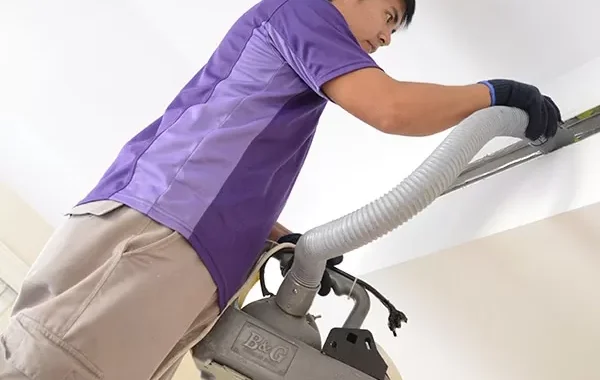
Clearing out an HVAC distribution system properly requires far more than sticking a shop vacuum hose down a floor register and hoping for the best. In the field, true source removal relies on placing the entire duct network under continuous negative pressure using industrial HEPA-filtered collection units. We start by sealing off all supply and return registers so the vacuum unit can establish strong airflow through the main trunk line. From there, we work branch by branch, introducing specialized agitation tools—such as forward- and reverse-sweeping air nozzles and soft-bristle rotary whips—that dislodge stubborn particulate matter clinging to metal corners and flex-duct ribbing without damaging delicate liners.
As those agitation tools travel down each run, the negative pressure immediately pulls the loosened debris straight into the containment unit rather than letting it blow back into your living space or office. During the process, a thorough technician also inspects the blower compartment, evaporator coil housing, and register boots for air leaks or disconnected joints. Seeing the before-and-after view on an inspection camera is usually the moment clients realize how much hidden restriction their system was fighting against every single day.
Keeping Your Air Clean Until Spring Arrives
Once your ductwork is cleared of built-up debris, maintaining that clean baseline through the rest of winter becomes remarkably straightforward. Start by checking your filter slot to make sure there are no gaps where bypass air can sneak around the edges, and swap out pleated media filters every sixty to ninety days during heavy heating months. Keep furniture, heavy drapes, and holiday decorations clear of supply registers and return grilles so your system can maintain balanced air exchange across every room. If you run a humidifier, inspect the water panel regularly to prevent mineral scale from entering the air stream.
Winter already demands enough from your property, from freezing temperatures outside to constant heating cycles inside. Giving your ductwork a clean slate ensures that the warm air circulating through your rooms is actually fresh, clean, and flowing freely. If your registers are showing gray dust halos, your rooms are heating unevenly, or you simply cannot remember the last time the inside of your air ducts was inspected, reach out to schedule a thorough diagnostic and cleaning before deep winter sets in.