
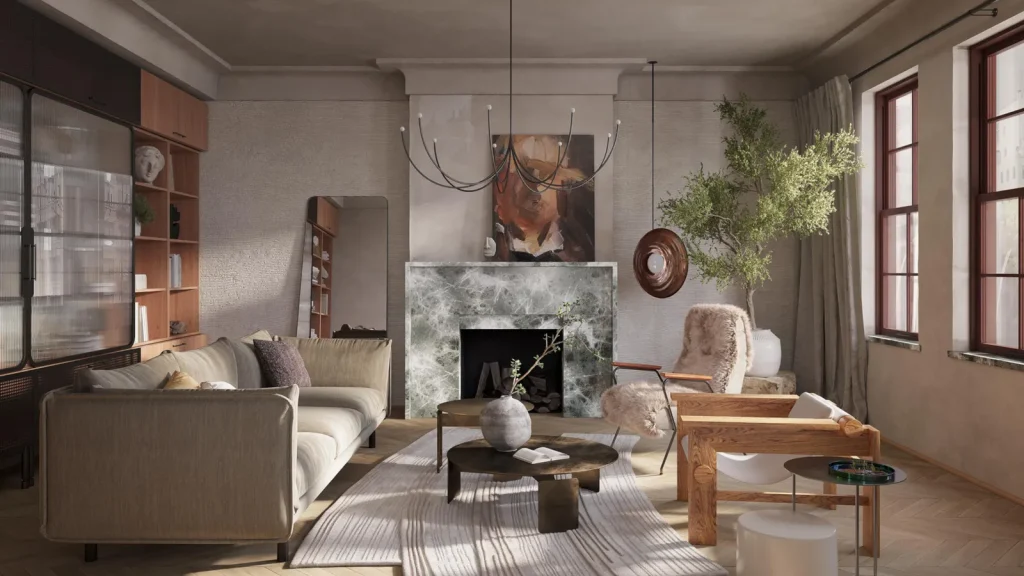
Limewash brings a quiet sense of motion to a wall without relying on pattern or obvious decoration. Its cloudy tonal shifts, soft edges, and mineral character can make even a simple room feel more layered. The strongest limewash wall ideas treat the finish as part of the architecture rather than as a decorative coating added at the end.
Let Natural Variation Do the Work
A limewashed wall looks most convincing when its variations are allowed to remain visible. Trying to make every section perfectly even can remove the quality that gives the finish its charm.
Broad brush movement creates overlapping areas of lighter and deeper color. That subtle irregularity works especially well in bedrooms, entryways, dining rooms, and quiet living spaces.
A useful approach is to keep nearby furnishings simple. Rather than filling the room with competing patterns, let the wall provide the visual movement while wood, linen, stone, and ceramic pieces add physical texture.
Build a Soft, Layered Color Palette
Muted earth colors tend to suit limewash because they reinforce its mineral appearance. Chalky white, warm beige, pale clay, dusty olive, and muted taupe can all create a relaxed result.
When gathering visual design references, focus less on copying a specific room and more on identifying how colors relate to natural light. A shade that appears nearly white in strong daylight may feel significantly deeper on a north-facing wall.
Test several large samples before committing to the whole room. Small paint chips rarely reveal how limewash changes once brush marks, wall scale, and changing daylight become part of the composition.
Use Limewash to Strengthen Architectural Features
Limewash can make simple architecture feel more deliberate. Alcoves, chimney breasts, curved openings, and recessed niches become more noticeable when subtle tonal movement follows their shape.
Interior planning inspiration can be useful while deciding which surfaces should receive the finish. Covering every wall isn’t always necessary. A single feature wall may create enough softness without reducing contrast elsewhere.
| Surface Choice | Visual Effect | Good Fit For |
|---|---|---|
| Full room | Soft, enveloping look | Bedrooms |
| Feature wall | Controlled texture | Living rooms |
| Alcove or niche | Added depth | Reading corners |
| Fireplace wall | Strong focal point | Lounge areas |
Curved walls are particularly effective because shifting daylight naturally changes their appearance throughout the day. The finish feels different from one angle to another without requiring extra decoration.
Balance Texture With Simpler Materials
Limewash already carries visible movement, so surrounding materials don’t need to compete. Smooth timber, plain upholstery, restrained metalwork, and lightly textured rugs usually give the wall enough breathing room.
A room assembled from comfortable interior references may include many tactile elements, but restraint still matters. Too many distressed surfaces can make intentional texture feel accidental.
Keep Trim Deliberate
Skirting boards, doors, and window surrounds can either match the wall tone or provide a sharper contrast. Matching finishes create a calm, wrapped effect, while painted trim gives the room clearer architectural boundaries.
Neither choice is automatically better. The decision depends on whether the wall should feel atmospheric or more clearly framed.
Where Limewash Plans Often Go Wrong
One common mistake is choosing limewash only because a heavily filtered photograph looks attractive. The real finish changes with daylight, substrate condition, application method, and the number of coats.
Another problem is adding too much rustic styling around it. Limewash doesn’t require antique furniture, distressed timber, or a farmhouse theme. In fact, pairing it with clean contemporary furniture can make the texture feel fresher and more intentional.
Frequently Asked Questions
Does limewash make a room look darker?
It can if the chosen tone is significantly deeper than the existing wall color. Pale mineral shades usually retain brightness while adding visible variation, especially when the room receives plenty of natural daylight.
Can limewash work in modern interiors?
Yes. Clean-lined furniture, modern lighting, restrained artwork, and smooth flooring can provide an effective contrast with the softer movement of a limewashed wall.
Should every wall in a room be limewashed?
Not necessarily. One or two walls may provide enough texture, particularly in compact rooms. Using the finish selectively can also highlight architecture without making the whole space visually busy.
Let the Finish Remain Imperfect
The most appealing limewash walls rarely look mechanically uniform. Choose a color that works in your actual light, test it at meaningful scale, and allow some brush variation to remain visible. When furniture and accessories stay restrained, the wall can carry much of the room’s atmosphere on its own.
